Silence

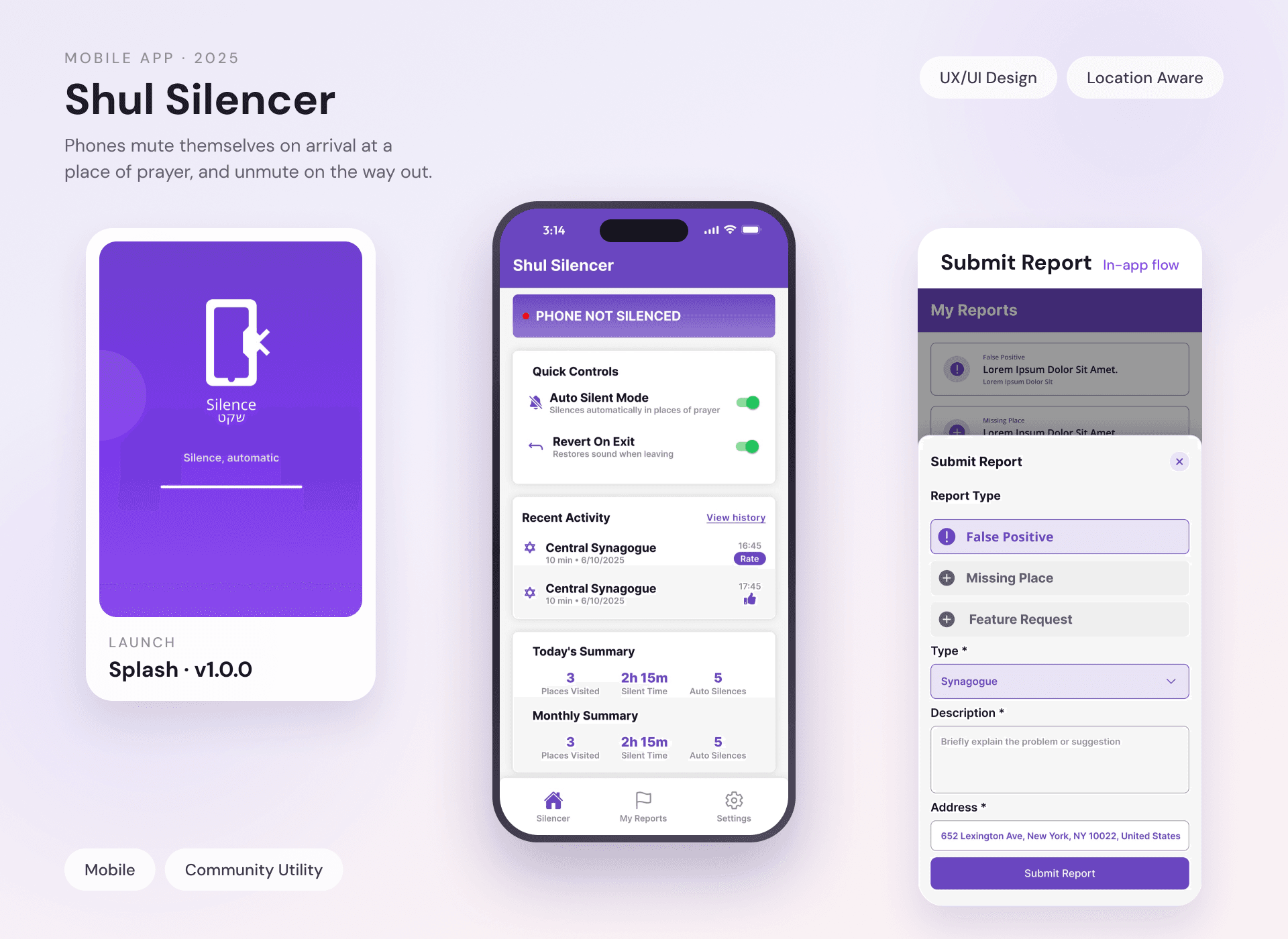
Silence is a location-aware mobile application that automatically manages sound settings around places of worship and gives users control over reports, history, and notifications.

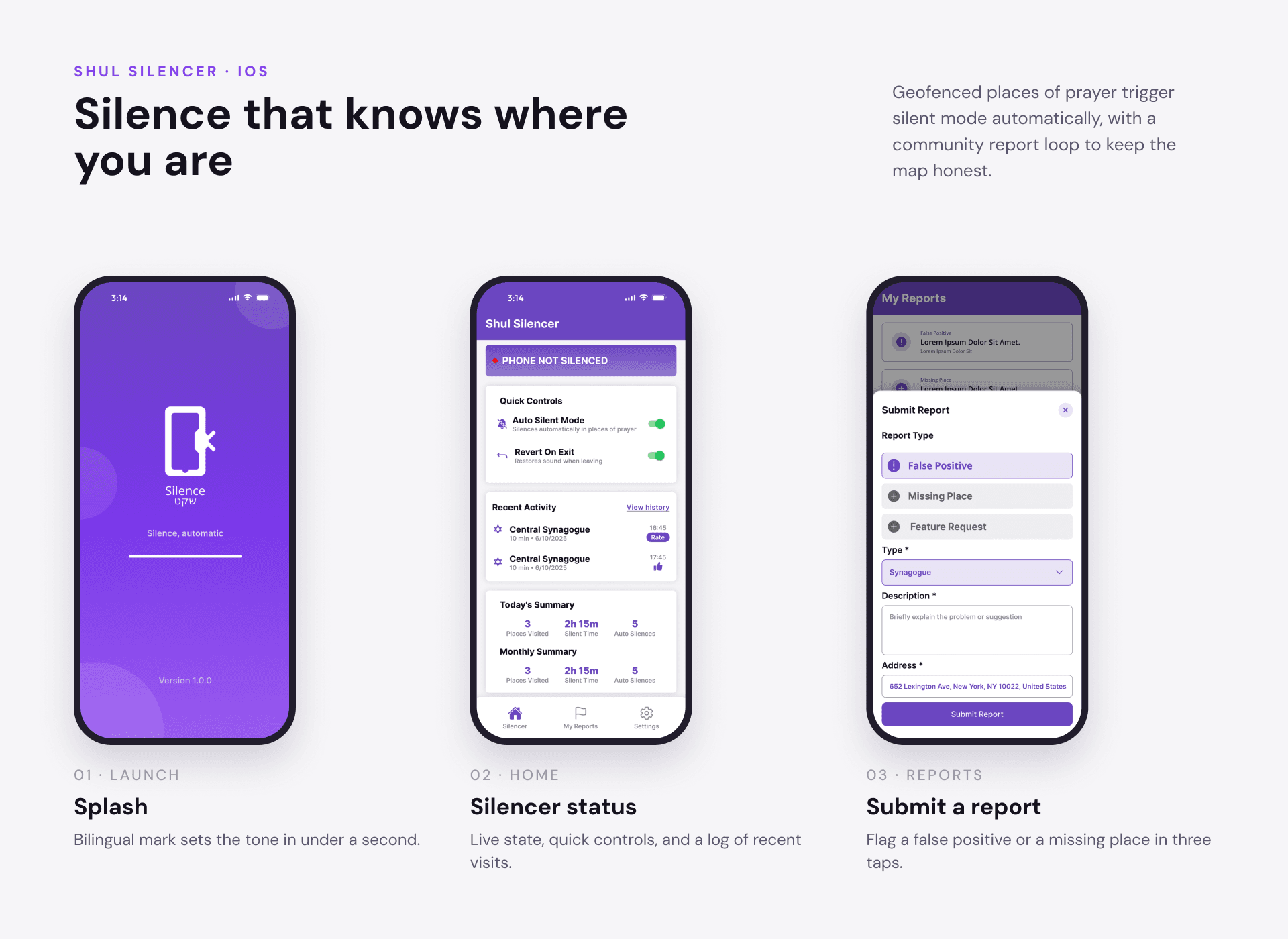
Silence mobile application shown across three phone screens

Project Overview

01

Israel

Location

02

6 Months

Duration

03

Mobile App

Platform

04

Location Intelligence & Lifestyle Technology

Sector

05

2 UX Designers, 1 UI Lead, 1 PM

Team

06

React Native, Python

Technologies

Executive Overview

THE CLIENT

The scope established by the client focused heavily on frontend agility, intuitive user journeys, and platform-specific optimization. Core requirements included:

  1. Cross-Platform Architecture: Creation of a single, high-performance codebase targeting both iOS and Android platforms using the React Native framework.
  2. Frontend UI/UX and API Integration: Architectural execution focused on user interface design, front-end client logic, and the seamless integration of pre-existing backend RESTful APIs supplied by the client.
  3. Zero-Barrier Accessibility: Implementation of an instantaneous "Guest Mode" and multi-lingual support to maximize global adoption without forcing upfront profile creation.
  4. Decentralized Mapping Logic: Requirement for community-driven reporting mechanisms so users can actively scale and correct the global database of religious coordinates.

PROJECT OVERVIEW

This case study examines the architectural journey of the SILENCER App, a high-utility mobile application designed to bridge the gap between modern technology and structural etiquette. The project centers on advanced geofencing and background system automation to ensure mobile devices are automatically silenced in designated religious and sensitive zones.

PROJECT GOALS

To fulfill the client's vision, the engineering team prioritized the following technical milestones:

  1. Autonomic Audio Automation: Engineering a background system to dynamically alter system-level audio parameters on entry and exit triggers without requiring the app to be open.
  2. High-Fidelity Boundary Accuracy: Establishing low-power geofencing algorithms that continuously monitor location changes while minimizing battery drain across diverse hardware.
  3. Crowd-Sourced Map Expansion: Leveraging community feedback loops to transform users into active validators for unindexed regional locations.
  4. Client-Side Privacy Preservation: Designing advanced metric suites that reside exclusively on local device storage to ensure total user anonymity.

THE CHALLENGE

Primary Technical Bottleneck

  • The primary technical bottleneck involved significant discrepancies in background execution privileges between the iOS and Android ecosystems.

Operating System Sandboxing Barriers

  • iOS Restrictions: Apple's security sandbox prevents third-party apps from programmatically overriding the physical mute switch. Concurrent geofences are limited to 20, and background execution is aggressively suspended if the app is swiped away.
  • Android Capabilities: Android grants deeper system access, allowing direct utilization of the native "Do Not Disturb" (DND) API. It supports high-volume geofencing and persistent foreground tracking services.

Engineering Mitigations & Workarounds

  • iOS Adaptive Fail-safes: Built a push-notification reminder pipeline tied to the iOS Visits API. This triggers a rich notification upon entry, allowing users to run custom Siri Shortcuts that silence the phone with one touch.
  • Android Persistent Layering: Utilized a dedicated Foreground Service with a persistent status bar icon, ensuring the OS does not harvest the app's background thread during memory-intensive tasks.
  • Offline Data Continuity: Implemented a local spatial caching network that pre-downloads nearby POW coordinates onto internal storage to mitigate signal drops in subterranean structures.

Implemented Core Features

  • Intuitive Onboarding: Streamlined workflow for location, notification, and Android DND permissions.
  • Authentic Guest Mode: Instant access to geofencing systems without mandatory registration or social login.
  • Community Validation Network: Tools to report false positives, submit missing coordinates, and vote on pending locations.
  • Local Metric Dashboards: Premium analytical tier compiling visit data and "hours saved in silent mode" stored locally.

Future Feature Opportunities

  • Calendar Sync: Integration with Google Calendar or iCal to cross-reference location checks with scheduled prayer times.
  • Wearable Companions: Native watchOS and Wear OS apps sending haptic patterns to bypass physical mute switch limitations.
  • BLE Beacon Mesh: Deploying low-cost beacons for hyper-accurate micro-location in areas where GPS fails.
  • AI Anomaly Filtering: Backend algorithmic layer to instantly filter malicious location submissions.
  • Wi-Fi Fingerprinting: Using unique SSID/MAC addresses to trigger silent profiles upon network connection.
Silence application report submission screen

Project Capabilities

Silence combines location intelligence, automatic sound controls, transparent settings, and community reporting in one calm mobile experience.

Respect Important Places Automatically.

Location-aware triggers help phones enter silent mode around supported places of worship and restore the previous setting after departure.


Location-aware place of worship illustration

Improve Accuracy Through Community Reports.

Users can document false positives, missing places, and feature requests so location information continues to become more useful and reliable.

People participating in a community session
01

Automatic Silent Mode

Silence the phone when entering supported locations.

02

Revert On Exit

Restore the previous sound state after leaving.

03

Visit Intelligence

Review history, places visited, and activity summaries.

04

Community Reporting

Report missing places, false positives, and suggestions.
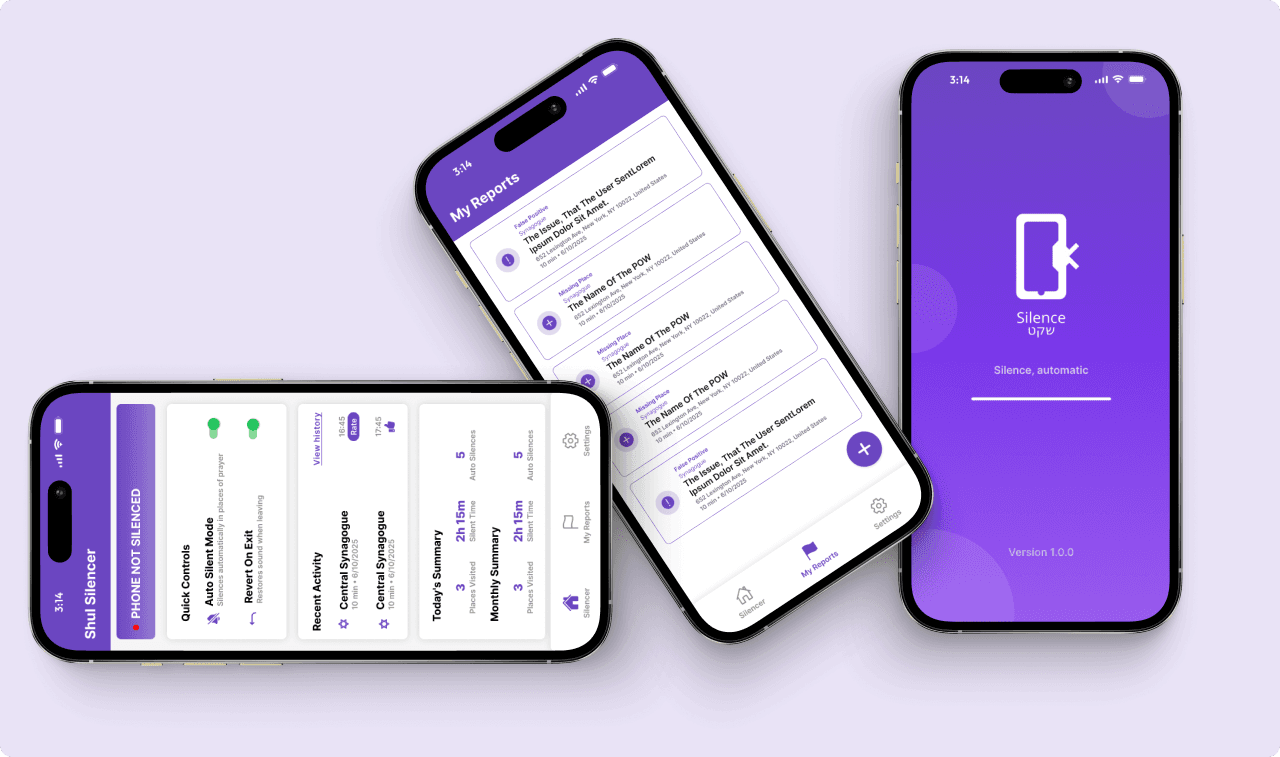
Silence mobile application settings screen

Brand Color Combination

Sa

Inter

MediumSemi BoldBold

Development Journey

1. Discover

Research location behavior, permissions, and user trust.

2. Define

Map sound controls, location triggers, and reports.

3. Design

Create the calm, accessible mobile interface system.

4. Deliver

Validate automation behavior and refine the experience.

Conclusion

Silence turns a sensitive location-based behavior into a clear and controllable mobile experience. Automatic sound management supports respectful environments, while transparent settings, visit history, and reporting tools keep users informed and in control.